


'%20x='0'%20y='0'%20height='100%25'%20width='100%25'%20%0A%20%20%20%20%20%20%20%20%20%20xlink%3Ahref='data:image/jpg;base64,/9j/2wBDAAYEBQYFBAYGBQYHBwYIChAKCgkJChQODwwQFxQYGBcUFhYaHSUfGhsjHBYWICwgIyYnKSopGR8tMC0oMCUoKSj/2wBDAQcHBwoIChMKChMoGhYaKCgoKCgoKCgoKCgoKCgoKCgoKCgoKCgoKCgoKCgoKCgoKCgoKCgoKCgoKCgoKCgoKCj/wAARCAAHAAoDASIAAhEBAxEB/8QAFgABAQEAAAAAAAAAAAAAAAAAAAUG/8QAIRAAAQIFBQEAAAAAAAAAAAAAAQMRAAIEBRQGEhMhQVH/xAAVAQEBAAAAAAAAAAAAAAAAAAAFBv/EABoRAAIDAQEAAAAAAAAAAAAAAAECAAMRBPD/2gAMAwEAAhEDEQA/ANvq2vv9o1NZFKfFVpKhbHCBJHJvIck+bem68P2Lc1+UlmIx5SxZ4QhqipGGke0ys4K1tBLjZ//Z'%3E%3C/image%3E%3C/svg%3E)

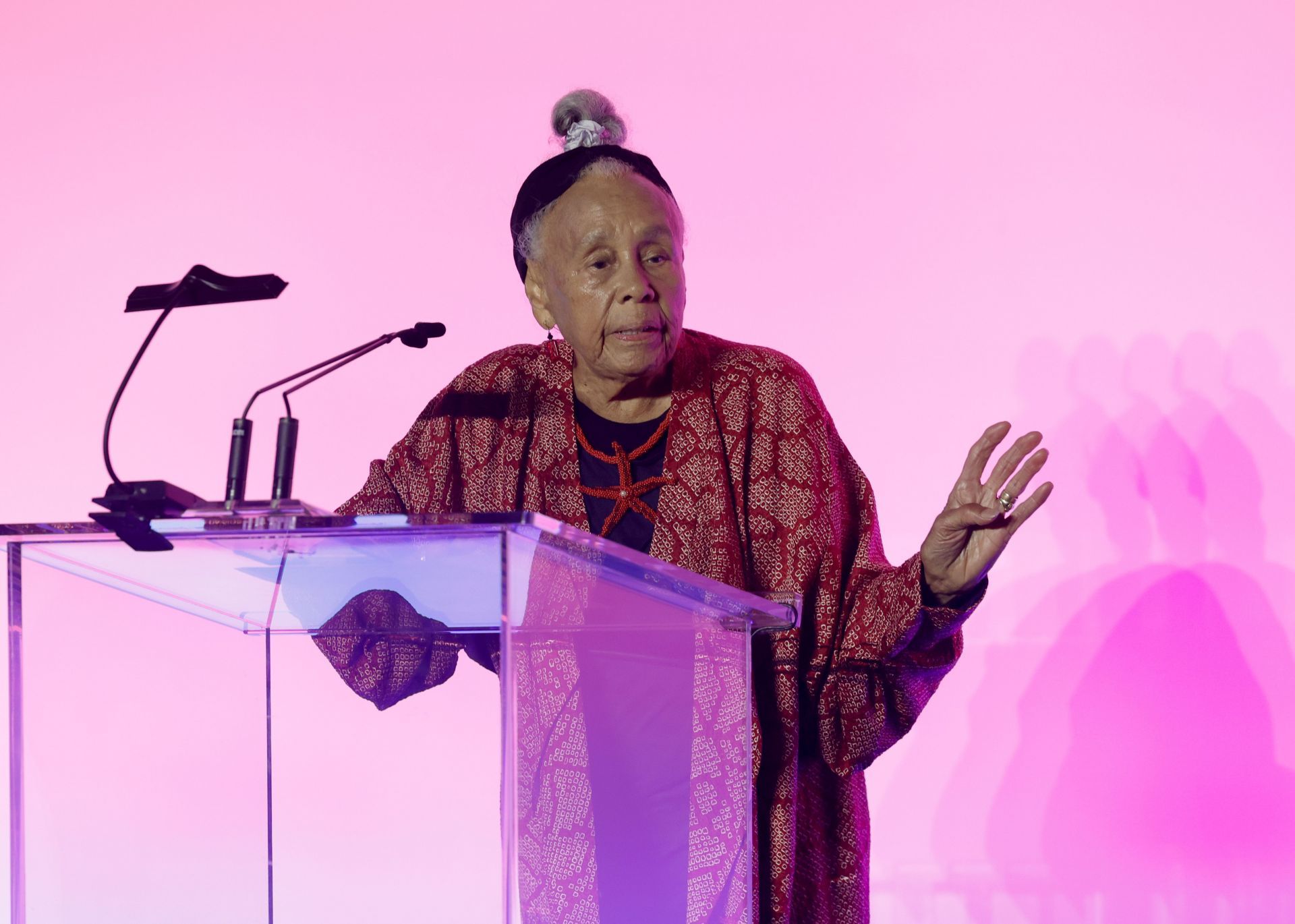
The creator of The Liberation of Aunt Jemima, Betye Saar, has passed away at the age of 99 on July 26 at her Los Angeles home. She reportedly died in her sleep.
Born Betye Irene Brown on July 30, 1926 in Watts, California, Saar passed away four days before her 100th birthday. She was a leading figure in the Black Arts Movement and a pioneering California assemblage artist. She became known for transforming discarded everyday objects, especially Jim Crow era memorabilia such as dolls and washboards, into sculptures reflecting Black Liberation.

Roberts Projects, the Los Angeles gallery representing Betye Saar said that her “symbolically rich body of work” demonstrated “the environmental, cultural, political, racial, technological, economic, and historical context” in which it exists.
Saar was married to a ceramicist named Richard. They were together from 1952 until their divorce in the late 1960s. They welcomed three daughters together - Lezley, Alison, and Tracye.
Continue reading for more details.
Everything you need to know about Betye Saar
Betye Saar’s longtime gallerist Julie Roberts at Roberts Projects described her as “one of the greatest artists of our time.” She said that it was an honor to work with her. She added:
“Her singular vision transformed the course of contemporary art, and her legacy will continue to inspire generations of artists, scholars, and audiences around the world.”
Saar was the eldest of the three children born to Jefferson Maze Brown and Beatrice Lillian Parson. She was of mixed heritage since her mother was of African, Native American and Irish descent, and her father’s heritage included African and Choctaw. They met while attending the University of California, Los Angeles.
Her father, a Methodist Sunday School teacher, died of kidney failure when Betye Saar was five. Reportedly, a hospital refused to treat him because of his race. After her father’s death, Saar grew up in Pasadena with her mother in a middle-class family.
Since Betye Saar’s mother was a seamstress, she grew up making gifts for her friends and family. While attending high school, Saar spent her final high school years studying ceramics, illustration, watercolors and art history at Pasadena Junior (now City) College. She graduated from the University of California, Los Angeles in 1949, earning a bachelor’s degree in design.
In the early 1950s, Saar worked as a social worker. She designed jewelry, home goods, and greeting cards and collaborated with enamel artist Curtis Tann in a small business.

She told a documentary crew in the 1970s:
“My work has to do with recycling. Each item I collect has a certain energy from its previous function that carries over into its new use.”
Betye Saar is best known for her 1972 revolutionary reimagination of Aunt Jemima. In her assemblage, she took a plastic “mammy” figurine of the image once used to market a pancake mix and syrup brand and altered it. Her work transformed the caricature showing a passive servant into an armed warrior. She placed a rifle in one hand while retaining a broom in another.
During an interview with the LA Times in 2016, Betye Saar said:
 Trending
“…they abolished slavery but they kept Black people in the kitchen as mammy jars. I had this Aunt Jemima, and I wanted to put a rifle and a grenade under her skirts. I wanted to empower her. I wanted to make her a warrior. I wanted people to know that Black people wouldn’t be enslaved by that.”
After her divorce from her husband, Richard Saar, Betye raised her daughters as a single parent. She continued to support her family through teaching and her art practice. Richard died in 2004.

Love movies? Try our Box Office Game and Movie Grid Game to test your film knowledge and have some fun!



 Reply
Reply


