


'%20x='0'%20y='0'%20height='100%25'%20width='100%25'%20%0A%20%20%20%20%20%20%20%20%20%20xlink%3Ahref='data:image/jpg;base64,/9j/2wBDAAYEBQYFBAYGBQYHBwYIChAKCgkJChQODwwQFxQYGBcUFhYaHSUfGhsjHBYWICwgIyYnKSopGR8tMC0oMCUoKSj/2wBDAQcHBwoIChMKChMoGhYaKCgoKCgoKCgoKCgoKCgoKCgoKCgoKCgoKCgoKCgoKCgoKCgoKCgoKCgoKCgoKCgoKCj/wAARCAAHAAoDASIAAhEBAxEB/8QAFgABAQEAAAAAAAAAAAAAAAAAAAUI/8QAIBABAAEEAAcAAAAAAAAAAAAAAQIAAwQREhUhMVOD4v/EABQBAQAAAAAAAAAAAAAAAAAAAAP/xAAZEQEAAgMAAAAAAAAAAAAAAAABAAIRMVH/2gAMAwEAAhEDEQA/AM44mNalfixgcUXUFdCHZTXVqhyfBfMez5pSitnsSiOyf//Z'%3E%3C/image%3E%3C/svg%3E)

Famous Last Words is a relative newcomer to the Netflix lineup, and its premise was an immediate topic of conversation and discomfort. Developed and hosted by Brad Falchuk, the show revolves around an emotionally complicated pact: every episode is shot with a celebrity, but it can only be aired once that person has died. It’s a series about dying, legacies, and final reflections, but also about timing, grief, and the uncomfortable place between tribute and loss.
That strain would become devastatingly real with the passing of Eric Dane on February 19 after what Falchuk calls a “heroic” struggle with ALS. Dane’s episode was streamed the day after, on February 20, 2026, confronting fans and the show’s creator with the stark immediacy of loss. Best known for his roles on Grey’s Anatomy and Euphoria, Dane was not just a guest on the series but also a close friend of Falchuk, the series creator, making this episode all the more hard to watch. Read on to know what Falchuk said about the incident.
Here is what the Famous Last Words host-producer said about Eric Dane’s Netflix interview

As mentioned, Famous Last Words episodes feature celebrities giving their last message, and the episodes only air after their demise. The recent episode was about Eric Dane, the actor who was diagnosed with ALS, a fatal neurodegenerative disease. Falchuk, the creator of Famous Last Words, was personally attached to the actor and was unable to process his death.
“I never want them to air,” Falchuk tells Gold Derby in an exclusive interview.
He further explained his dilemma, speaking out of intense emotion.
“The conversations are really moving and beautiful, and what Eric had to contribute in this conversation is so profound and so important and so needed at this moment. I shouldn't be the only one that gets to experience his brilliance. And at the same time, I never want them to air. When I got the news last night, it was hard. They mean a lot when they air, but they also represent that that person really is gone.”
For Falchuk, that puts a double burden on each of its episodes: it reveres the subject’s voice, but it also confirms their absence. The death of Dane, in particular, was a blow.
“I saw him just a few days ago, and he seemed good,” Falchuk says. “So, I wasn't expecting this at all. I want to honor him and honor the show, but I'm definitely grieving and feeling a lot for his kids.”
Dane’s interview in Famous Last Words followed the same protocol as previous guests, including Jane Goodall, whose episode aired last October under the same agreement. Each party agrees to have its conversation released only post-mortem, a framework meant to leave room for rawness. The format enables guests to talk openly about their lives, regrets, and relationships, as well as the inevitability of death, without the encumbrance of immediate public scrutiny.
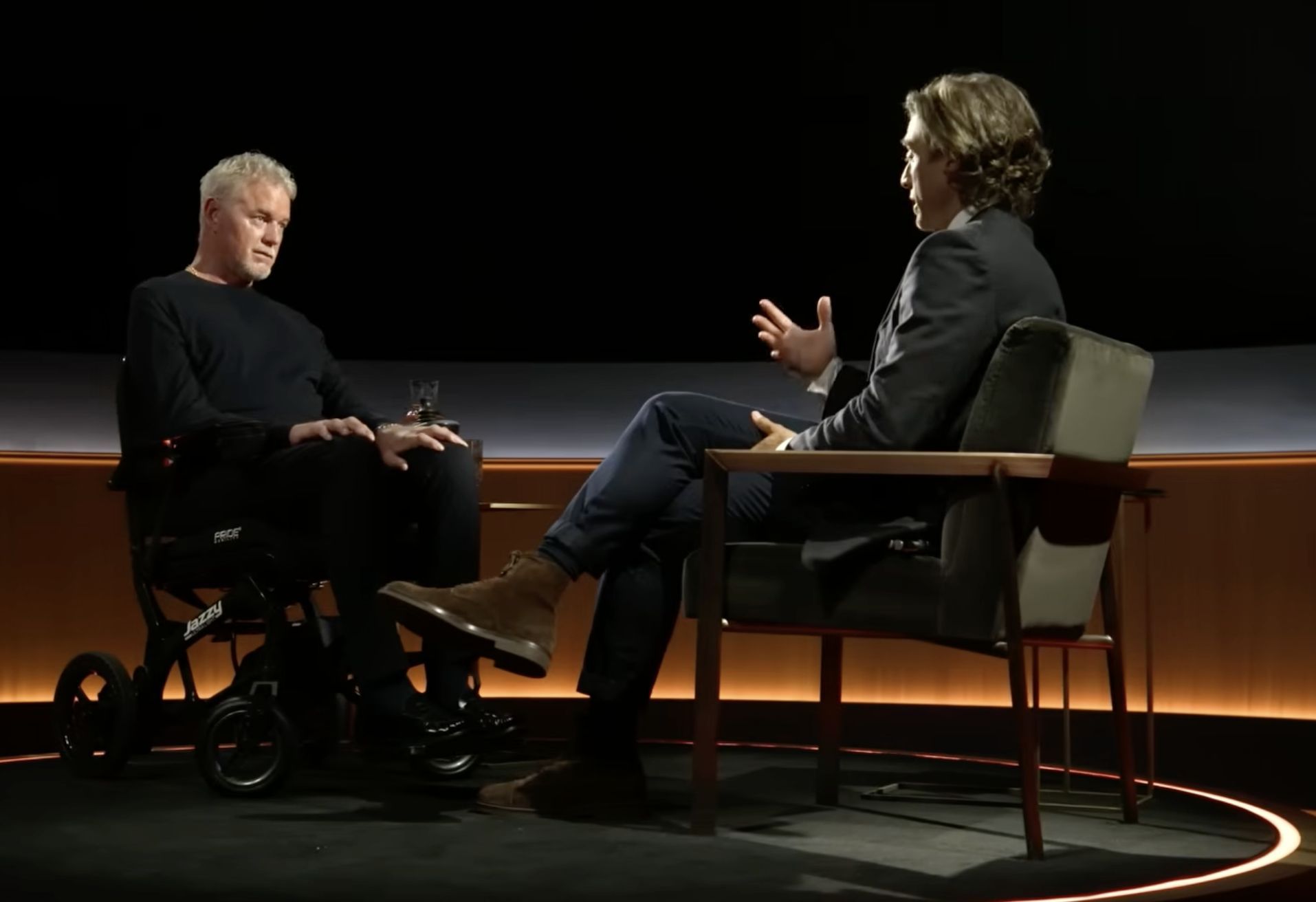
In Dane’s case, his last words to his two daughters, Billie and Georgia, whom he shared with actress Rebecca Gayheart, were released unedited and in full. The taping in November, however, was deliberately cozy on Famous Last Words. None of Dane’s family members were present.
“It was just him and me,” Falchuk says. “We really try and keep it as private as possible, so that the guests can speak freely and safely about anything and anyone, and not have to worry about hurting anybody's feelings. They're also talking about their own death, and I wouldn't want their family members around for that. The guest is ready to deal with it. I don't know if their family members are.”
 Trending
This philosophy lies at the emotive heart of Famous Last Words. The series is not spectacle but a quiet reckoning, one in which public figures are allowed to confront their own endings on their own terms. But for Falchuk, who must later guide these episodes out into the world, the feeling is still intensely personal and fraught.
Each season premiere is a salute and an adieu. And as Dane’s episode proves, the series’ most affecting moments are indistinguishable from actual grief. Falchuk may believe that the audience should be able to know what his guests have left behind, but that belief doesn’t make broadcasting any easier.




 Reply
Reply


